Ron Holland Could Be Detroit's Best Trade Chip for an Offensive Fix
- Cargo
- Trades & Signings
- Shipped
- Shipper
- Cem Yolbulan
- Readers
- 907
Ron Holland's $9 million salary and uneven Year 3 make him a useful matching piece as the Pistons look for a scoring boost before the February deadline.

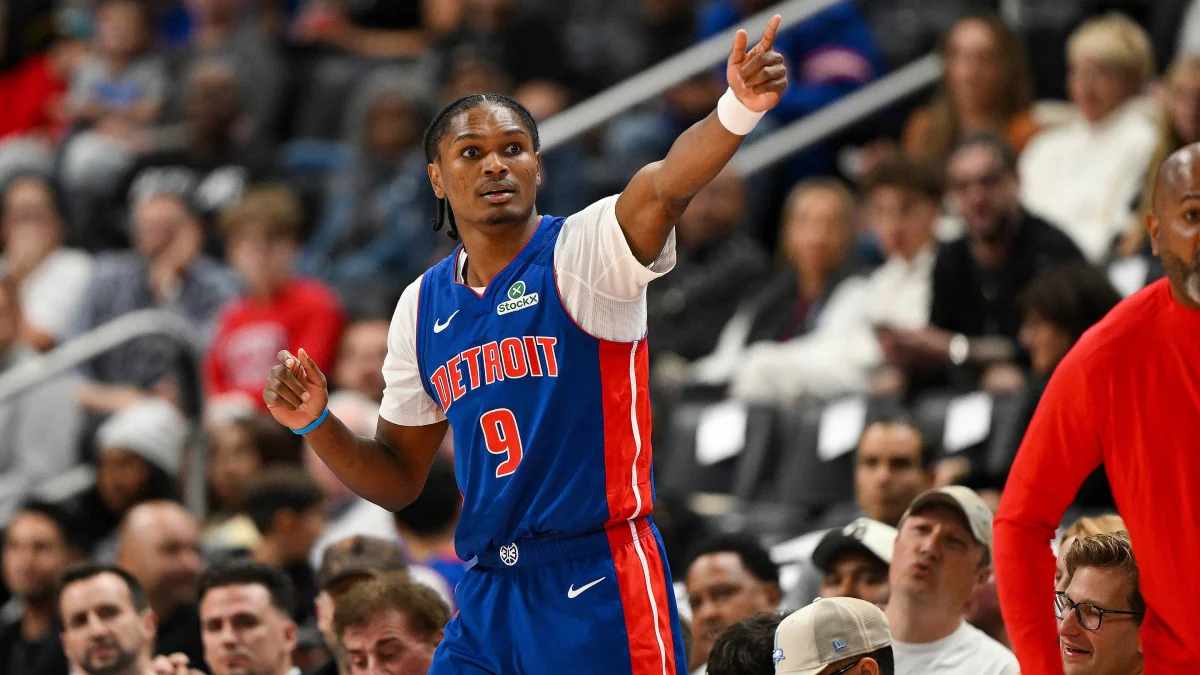
The Pistons have a scoring problem that won't fix itself, and the player most likely to be moved to address it is one they've been hoping would develop. Ron Holland's $9 million salary and his limited progress in Year 3 make him more useful as matching salary than as a building block right now. That's the angle that makes the February trade deadline interesting for Detroit.
Why Holland is the piece to move
Detroit's need for more offensive punch has been obvious for a while. It held them back in the playoffs last year, and it's still the weakest part of a roster that wants to contend this season. Any upgrade has to create shot-making without costing the defensive identity the Pistons built, and that's where the trade math gets complicated.
Holland's case is mostly about fit and contract. He hasn't made the jump many expected in his third season, and his game has looked awkward next to Ausar Thompson, who occupies a similar defensive-first lane. Put those two side by side and the spacing and roles get crowded. His salary, meanwhile, is big enough to match against a higher-paid veteran, which is exactly what a team like Detroit needs in a deal. Attach some draft capital and the package starts to look like something another front office could take seriously.
My read is that Holland's value to other teams is probably higher than his value to Detroit at this point, and that's a conversation the front office has to be honest about. None of the names below are reported talks. They're fits on paper, and each one carries its own cost.
Ty Jerome: the high-end option with a price tag
Jerome is the most eye-catching name, and the production justifies the attention. The 29-year-old point guard has been one of the more dominant scorers in the league this season for Memphis, averaging 27.4 points, 3.6 rebounds and 5.3 assists per game on 50.4/37.5/87.0 shooting splits. Those are the numbers of a player who changes how a defense has to play him.
The Grizzlies have been winning with him, which is why they'd have little reason to move him if the momentum holds. That's the part that makes this a longer-term question. Teams that ride a hot streak often see it level off, and if Memphis starts looking more like a Play-In team than a Western contender, the calculus shifts. That's when a rebuild-minded front office starts listening to offers.
Jerome is on a $9.2 million salary this season with a $9.6 million player option for next season. Given his form, the expectation is that he'd decline that option and push for a long-term extension, which means any Detroit pursuit would be a commitment to his next deal too. A package built around Holland plus first-round picks would be the price of entry, and that's a steep one. Still, it's the kind of trade that would give the Pistons the playmaking and scoring punch they've been missing.
Ryan Rollins: the buy-low profile
Rollins is the quieter option, and that's where the value might be. He was a high-end starter for Milwaukee last season, but he's started this year slowly and recently lost his starting job to rookie Brayden Burries. Teams sometimes trade players in that spot because the minutes have dried up, which can create a window for a buyer.
His profile suits Detroit's roster. He can handle the ball, pass, shoot and defend, and the Pistons don't have many players who do all four at a reasonable level. He's 24 and earns $4 million, so he's young enough to grow with the roster and cheap enough to fit into a deal without straining the cap. He will need a new contract over the summer, and that's a real cost to factor in, but a long-term backcourt option at his age is worth the conversation.
The catch is that a deal for Rollins would likely cost a first-round pick, and that's a meaningful asset. Detroit would need to decide whether a solid, fit-friendly guard is worth more than the pick it would surrender. My view is that he's a worthy swing if the price is right, but not a bargain at any price.
Norman Powell: the easiest to acquire, the hardest to match
Powell is the most practical target in terms of availability, but the salary math is the hardest part of this list. He's on a $21.5 million contract this season, which means Detroit would have to add more salary in any deal. Kevin Huerter or Isaiah Joe would likely be the names included to make the numbers work, alongside Holland.
Interest isn't the question here. Detroit reportedly pursued Powell during free agency before he signed with Chicago, so the Pistons already know he's a player they want. The Bulls are off to a rough start and aren't positioned to contend, which could make them receptive to a change of direction. Powell is struggling along with the rest of the team, but he earned his first All-Star selection last season. If he gets back near that level, he could be the secondary shot creator and scorer Detroit needs.
The risk is paying a higher price for a player whose form has dipped. Still, Powell offers a more established scoring track record than either Rollins or Holland, and that makes him the option most likely to change the shape of the Pistons' offense quickly.

What to watch before the deadline
Here's the thing: every option here runs through Holland, and that makes his trade value the central question. If other teams don't see him as a useful piece, Detroit's options shrink fast. If they do, the Pistons have leverage to ask for a player who can change their offense rather than a marginal rotation upgrade.
Watch how Holland's role evolves over the next few weeks, and whether the Pistons keep leaning on the Thompson pairing. Watch Memphis's results, since a slide would change the Jerome conversation quickly. And watch Chicago's standing, because a fall in the standings is often what pushes a veteran like Powell onto the market. The February deadline will reward whichever front office moves early with a clear plan, and Detroit's need for scoring makes that plan urgent.