Oilers’ 5-2 Win Spotlights Florida’s Five-on-Five and Goaltending Problems
- Cargo
- NHL Games & Standings
- Shipped
- Shipper
- Ryan Gagne
- Readers
- 748
Edmonton beat Florida 5-2, exposing five-on-five and goaltending concerns as the Panthers work to prove they can compete with top teams.
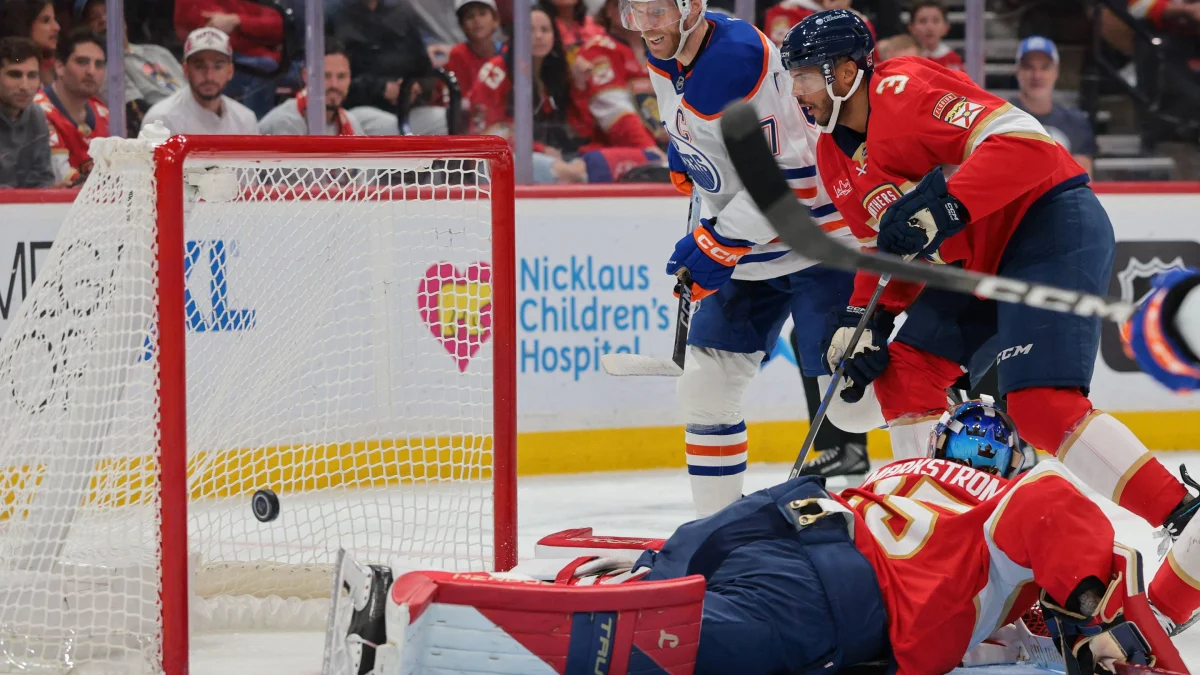

Florida’s 5-2 loss to Edmonton on Tuesday was most revealing before the Panthers finally found the net. The Oilers built a 4-0 lead, leaving Florida to chase the game in the final 10 minutes. The Panthers finished ahead in shots and outhit Edmonton 40-19, but those edges couldn’t erase the gap in finishing, defensive coverage and goaltending.
The result adds to a broader concern through 23 games: Florida has had trouble controlling even-strength play and has yet to show consistent results against teams currently in playoff positions. The Panthers are 12-8-3, a respectable record on its own. The underlying split between their overall production and five-on-five results makes the start less convincing.
Edmonton is winning the even-strength comparison
Florida has scored 72 goals and allowed 68, for a plus-four differential across all situations. At five-on-five, though, the Panthers have scored 38 and conceded 44. Edmonton’s figures run the other way: the Oilers lead the NHL with 91 goals for and have allowed 60, while their five-on-five differential is plus-11, with 47 goals scored and 36 allowed.
That creates a 17-goal gap between the teams at even strength. It’s a notable reversal for a Florida club that has built its identity around pressure, physical play and contributions from across the lineup. The Panthers have received offense from Matthew and Brady Tkachuk, Sam Reinhart, Anton Lundell and Seth Jones, but the overall numbers point to a team that hasn’t kept enough pucks out of its net.
Edmonton’s attack still leans heavily on Connor McDavid and Leon Draisaitl. They combined for five points against Florida—two for McDavid and three for Draisaitl—and reached 99 combined season points. The entire Panthers roster had 190 points, so the Oilers’ two stars accounted for the equivalent of just over half that total. Yet Edmonton’s advantage at five-on-five suggests its threat extends beyond its headline scorers.
Both clubs can hurt opponents on the power play. Edmonton ranked second in the NHL at 35.1 percent, with 24 power-play goals; Florida ranked 10th at 24.2 percent, with 22. Special teams help explain how each team has built its scoring, but Florida’s negative even-strength differential leaves less room for a quiet night with the man advantage. In the postseason, opportunities to draw penalties can be harder to count on.
Goaltending remains a key question
Florida’s goaltending numbers sharpen the concern. Through 23 games, Jacob Markström, Akira Schmid and Cooper Black had combined for a .890 save percentage and a 2.78 goals-against average. Markström, the team’s No. 1, had a .898 save percentage and 2.56 goals-against average. Schmid’s figures were .885 and 2.98; Black had a .857 save percentage and a 3.15 goals-against average in his lone appearance.
Markström’s record against Edmonton also took another hit Tuesday. After years in Calgary, he now stands 15-18-2 against the Oilers, with a 3.02 goals-against average and .897 save percentage in those games. One matchup record doesn’t settle what Florida can expect from him next, but the larger team numbers leave little margin for error behind a defense that has already conceded more goals at five-on-five than it has scored.
Florida’s goalies can’t be assigned every defensive breakdown or bad bounce. Still, the current results look far removed from the goaltending that helped the Panthers reach three straight Stanley Cup Finals from 2023 through 2025. If these teams meet again in the final, Edmonton’s top-end skill would make a slow start especially costly. Tuesday’s four-goal deficit showed how quickly the game can tilt before Florida’s offense gets going.
Results against playoff teams need to improve
Florida’s absences were part of the discussion after the loss. Some fans argued the Panthers had kept Edmonton in check apart from two power-play goals; others pointed to Aleksander Barkov and Brad Marchand being out of the lineup. Those absences matter, and both players could strengthen the team when they return. They don’t answer whether Florida’s five-on-five play and goaltending will improve.
The record against playoff-position opponents is another test. Florida beat Carolina on Opening Night, then lost in regulation to Minnesota, Ottawa, Boston and Edmonton, and fell to Dallas in overtime. That leaves the Panthers 1-4-1 in those games, with three points from a possible 12. Against everyone else, they are 11-4-2.
That split suggests Florida has been more comfortable collecting results against the rest of the field than measuring up against stronger competition. Injuries can make that test harder, but the Panthers have enough talent to remain competitive. They now need the returning players to help, while the rest of the lineup tightens its even-strength game and the goaltending stabilizes.
Edmonton has vulnerabilities of its own: its offense depends substantially on McDavid and Draisaitl, and its power play is a major weapon. But through 23 games, the Oilers have also held the better five-on-five numbers. Florida’s 12-8-3 start leaves time to change the story. The clearest signs to watch are whether the Panthers can reverse their even-strength differential, get more dependable saves and take points from the teams around them in the standings.